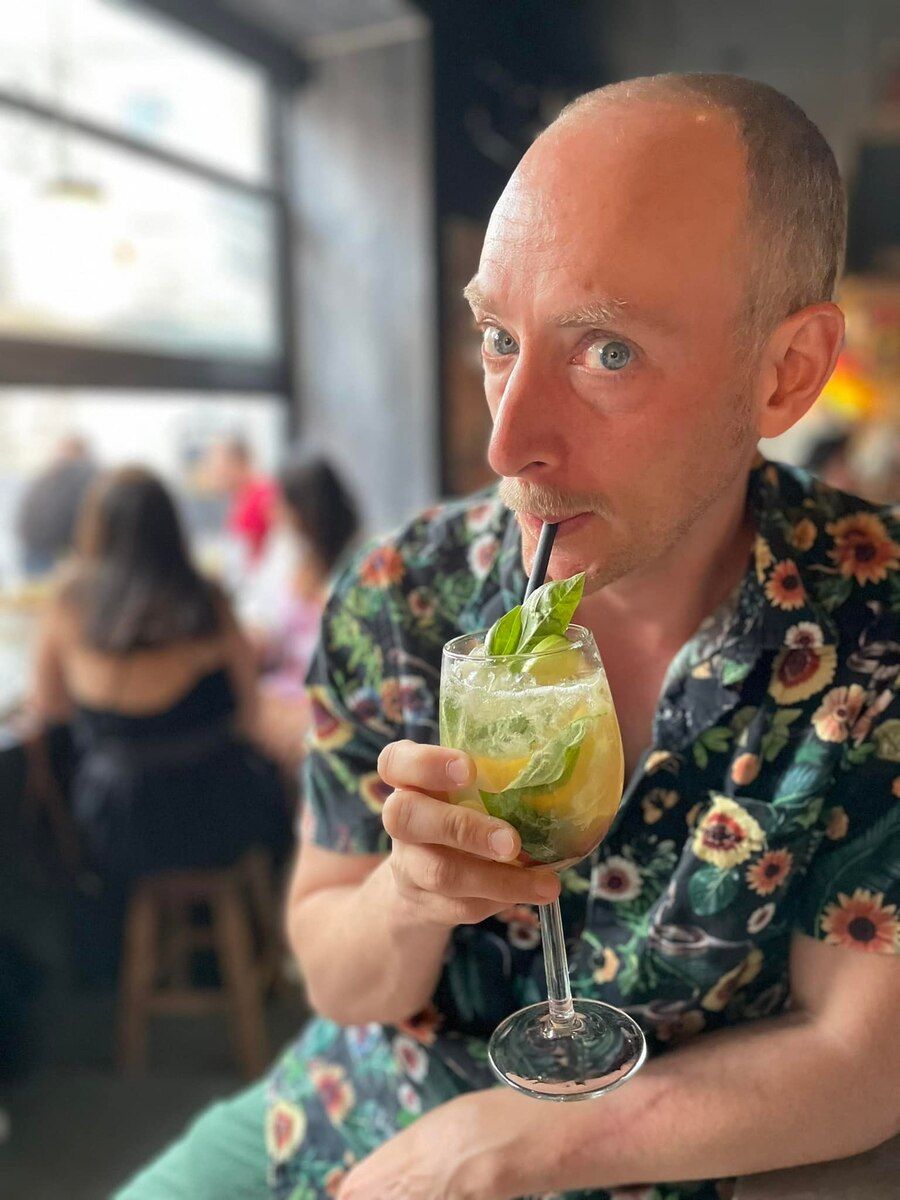

Brick chicken, the White Noise cocktail, and the burger at Lonnie’s, a new neighborhood restaurant in Boerum Hill, Brooklyn. Photos: Matt Gross.
What's in this email:
There’s this restaurant in my Brooklyn neighborhood I can almost guarantee you’ve never heard of. It’s Italian, one of many, many Italian restaurants in the area. Some of those are old-school, red-sauce relics of Carroll Gardens’ century-plus history as a destination for Italian immigrants. Some are new-school, because who doesn’t like Italian food? And some are new-school reinventions of old-school relics, because the neighborhood isn’t actually quite so Italian any more, and the restaurateurs’ heirs would rather not be restaurateurs themselves.
The restaurant I’m talking about, however, doesn’t really fit into any of those categories. It opened in 2003, too late to be considered old-school and too long ago to be new wave. The menu isn’t infinite permutations of tomatoes, nor is it gold-leaf risotto or letter-perfect recreations of dishes from, say, Pantelleria or Alto Adige. It’s neither experimental nor bound by tradition. This place is certainly pasta-focused, though, with many of its noodles, gnocchi, and tortellini made in-house, with a freshness you can taste, and sauces that roam the boot, from Naples (clams with cherry tomatoes) to Abruzzo to Venice to Rome (amatriciana — with garlic and onions, haters!). It’s not extravagant, but it’s good — satisfying, flavorful, consistent. That last adjective is important, because you don’t go there for surprise or innovation, transcendence or discovery beyond the occasional seasonal special. You go because the restaurant does precisely what it sets out to do, which is make quality food in a relaxed atmosphere and at a reasonable price point, day after day, month after month. To be honest, I haven’t been to this place in years, but I’m confident that if — no, when — I return, it will feel unchanged.
Should you go to this restaurant? Of course not!
I mean, if you happen to be or live in the neighborhood, then sure, by all means. You’ll love it. But if you’re visiting from out of town, there are a hundred other restaurants I’d suggest to you before this one. And if you live in Manhattan or Queens or even all the way over in Park Slope or Williamsburg, there’s just no need. This is a neighborhood restaurant, after all. And don’t you people have neighborhood restaurants of your own to rely on?
The thing is, of course, the concept of the neighborhood restaurant is changing. I don’t have precise data on this, but over the past year I feel like I’ve seen that phrase — “neighborhood restaurant” — appearing with far more frequency in Grub Street, the New York Times, Eater, and elsewhere. Whereas a few years ago the buzz was about empire building in the restaurant world (e.g., Carbone), now the cool openings are presenting themselves as more modest — not the first stake in a burgeoning franchise, not a shot at New York Times stardom or a James Beard Award, just a good place for good food and good drinks that also happens, I imagine, to be a good business. But is this all just marketing-speak, cover for more traditional fine-dining ambitions? What do they — and what do we — even mean by “neighborhood restaurant”?
What is a neighborhood restaurant, anyway?
You surely have your own idea of what defines a neighborhood restaurant. Maybe it’s about reflecting the community — serving dishes with roots in the people and histories from the surrounding area, with prices appropriate to the cost of rent. Maybe it has to do with the staff: servers who walk to work, a bartender you recognize from Pilates, a chef with kids at the elementary school around the corner. Or perhaps it’s the clientele: Everyone should look more or less like you and your neighbors, and you should be running into friends there all the time.
For me, a neighborhood restaurant has to have one defining characteristic: It has to be the kind of place where, at 6:45 p.m. on a random weeknight, when I realize I forgot to defrost the chicken I was planning to roast for dinner, I can easily get a table for four. In other words, it has to be the kind of place people in the neighborhood feel like they can simply pop into, whether to see their friends, to have a drink and a snack, or to avoid turning on the oven for the umpteenth time this month.
It’s that sense of openness, of welcoming in the spontaneous or disorganized customer, that goes a long way toward ensuring the neighborhood restaurant is never empty, and that buzz — of familiarity, of conviviality — keeps us all coming back, and keeps the restaurant thriving. We wind up creating the consistency we crave.
How do you define a neighborhood restaurant? Tell us in the Shut Up ‘n Eat community forum! It’s like a neighborhood restaurant itself, only we don’t serve food or drinks.
What a neighborhood restaurant isn’t
Earlier this summer, I got wind of a new restaurant opening in my neighborhood, one that was trying overtly to be a neighborhood restaurant. It was called Lonnie’s, and it was going to replace a business that definitely was not a neighborhood restaurant: Cafe Kitsuné, which had always felt cold and impersonal and unattuned to the needs of the surrounding blocks, more targeted to a Williamsburg clientele than Boerum Hill. And Cafe Kitsuné itself had replaced what was very much a neighborhood restaurant, Building on Bond, where you could get coffee and croissants in the morning, huevos rancheros at brunch, a cocktail and steak-frites in the evening. BoB’s food was far from spectacular, but they had plenty of space and decent prices, and so everyone loved it. Would Lonnie’s, we all hoped, be BoB reborn — or, we feared, a Kitsuné clone?
At first, Lonnie’s was neither. It was something else entirely. The owners, Sean Rembold and Caron Callahan, were known quantities: Callahan is a famous fashion designer, and the pair had a few years earlier opened Inga’s Bar, a restaurant in Brooklyn Heights, whose relative isolation more or less guaranteed it would be and remain a neighborhood joint. Lonnie’s arrived in June 2026 with as much hype as hope, and I knew, well, I probably couldn’t just pop in. I was going to have to make a reservation. So I did.
Unsurprisingly, Lonnie’s was good. My wife and I had, and loved, the grilled octopus, a pea salad, brick chicken, bracing cocktails: This was more than good — it was very good. (Sorry for using such highly technical food-writer terms!) And that, I could tell, was going to be a problem for its neighborhood-restaurant status. The word would get out. People from beyond the neighborhood, the city, the country would make Lonnie’s a destination. And I would never get a chance to return for the burger, either as a walk-in (the front bar is set aside for walk-ins) or with a now impossible-to-snag reservation. Lonnie’s would turn out to be too good for its own good — or at least for my own good.
And that’s what happened — at first. By mid-July, The Infatuation was declaring that Lonnie’s had “Brooklyn’s best new burger.” And in early September, a New York Times review — which dubbed Boerum Hill “the West Village of Brooklyn” — declared, “OK, So This Is How You Run a Brooklyn Restaurant”:
Lonnies is the kind of place that’ll make you feel like a regular, even if you’ve never before sipped on one of the bar’s smooth gin martinis or come face-to-face with the saucy dry-aged burger.
But would there ever be actual regulars at Lonnie’s? Before my first real visit, I’d shown up one evening at 5 p.m., hoping to get a drink at the walk-in bar, and found a long line waiting for Lonnie’s to open its doors. Already I was too late for a stool; I went elsewhere that night. And I wasn’t sure if I wanted to risk trying to walk in again. There’s nothing more demoralizing than being turned away from your local.
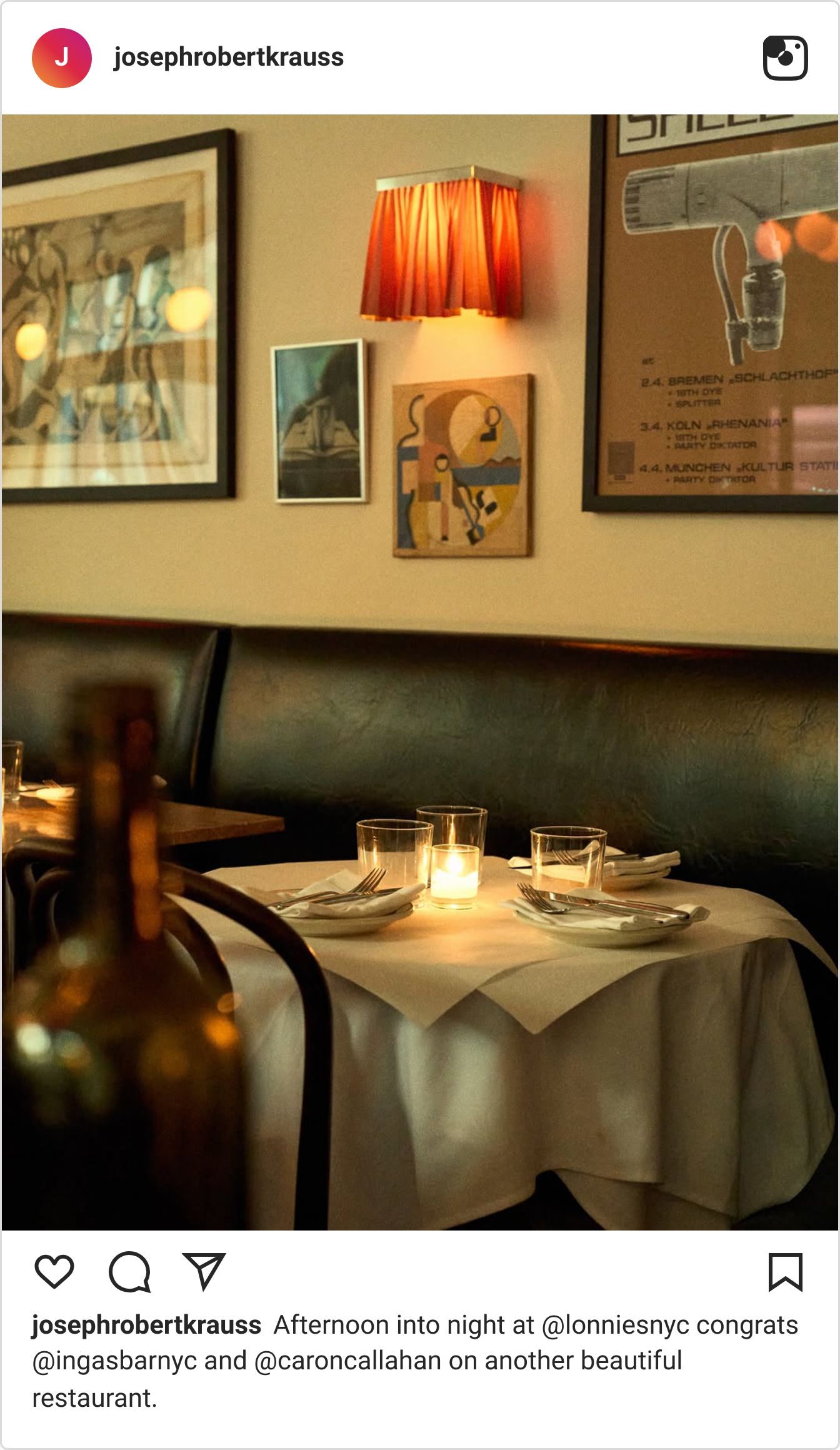
Still, in mid-July, I gave it another shot, stopping by around 7:15 with my friend Allison, and after a brief wait we scored two stools at the bar. The martini was as smooth as the Times would later claim, and the burger lived up to The Infatuation’s headline. It was an excellent meal, in part because Lonnie’s did what neighborhood restaurants are supposed to do — they made it easy.
Last week I returned again, at the end of a Wednesday night out with another friend. It was just before 10 p.m., and the place was mostly empty, so seats at the bar were not a problem. As we ordered drinks, though, that emptiness struck me: Was this just a typical late weeknight? Or had the hype cycle moved on already?
It might have been a bit of both, of course, but it gave me a weird kind of hope, a sense that in the near future the furor over Lonnie’s — over all the new neighborhood restaurants that happen to be too good for their own good — will die down, and Lonnie’s can become what it ostensibly set out to be, a spot that locals are proud to call their own, even (or especially) if no one more than two subway stops away remembers that it exists. It might take a decade to reach that point, but if I’m still here then — if any of us are! — I’ll let you know. Meet me at my local, and I’ll tell you all about it.
Fresh-Roasted Coffee, Without Leaving the House

A third-generation LA roaster ships 50+ coffees — single origins, flavored favorites, decafs, even teas — days after roasting. Mix and match Keurig®-compatible boxes for tiered savings up to 34% off. First order? Take an extra 15% off, automatically.
Who won Chef vs. Robot: Lysée Edition?
We put Eunji Lee, chef at Lysée, up against ChatGPT and asked them each to create a dish using zucchini blossoms, tofu, and uni. Then we asked you which you’d order at a restaurant. The results:
🟩🟩🟩🟩🟩🟩 Chef Eunji Lee's steamed zucchini blossom “dumpling” stuffed with minced tofu, pork, and zucchini, topped with raw uni and French sea salt
🟨🟨🟨⬜️⬜️⬜️ ChatGPT's chilled silken tofu topped with steamed uni-stuffed zucchini blossoms, in a dashi-soy broth
Congrats, chef Eunji! We look forward to one day tasting this imaginary creation!
And don’t forget, there’s still time to vote in Chef vs. Robot: Corima Edition, where chef Fidel Caballero and ChatGPT were challenged to invent a dish using corn, pistachio, and SPAM. Vote now!
Which dish would you order?
The best things Peter ate this week

Shimamoto’s tsukemen.
Our friends Clarissa Wei and Christine Liu, co-founders of HEYDOH soy sauce, were in Los Angeles as part of their cross-country roadshow and invited me to a fun dinner at Johnny Lee’s Rasarumah. Chef Johnny prepared a special menu just for us, using HEYDOH on all the dishes. Johnny is famous in food circles for his Hainan chicken (at his previous place Pearl River Deli), and he served a version of that, soy sauce chicken, which was juicy, tender, and beaming with HEYDOH flavor. A couple months ago in NYC, HEYDOH collaborated with Lisbonata to add soy sauce to their soft serve, so I was pleasantly surprised to have a pandan soft-serve dessert with HEYDOH, probably my fave dish of the night.
I’ve written about Keizo Shimamoto’s ramen burger before, but I wanted to try his new place in Irvine, located in a ghost kitchen, not far from the John Wayne Airport. Shimamato is a labor of love, as only Keizo is there full time, with occasional help from his family. His tsukemen lived up to my hopes and dreams —the noodles were perfectly chewy and the dipping broth meaty, with a sprinkle of fish powder flavor. Probably my favorite tsukemen in America!