
What's in this email:
A good dessert has layers: There are contrasting flavors and textures, often multiple components, playing off one another in harmony. Take my favorite pastry of all time, albeit more of a breakfast item than a dessert: the croissant. Without layers of dough and butter twisted into a weird shape bookended by two glorious peaks of crispness, it’s just a buttery yeasted roll — which, OK, not bad. But not a thing that inspires deep awe and intrusive longings.
Our guest on this week’s podcast, chef Eunji Lee of Lysée in New York, makes desserts with layer upon layer of flavor, texture, mission, and meaning. The bakery’s name is a portmanteau of musée, French for museum, and her last name, fitting for a Korean-born chef who studied pastry in France and aspires to create an edible art gallery with her confections. Like one of Lee’s signature pastries, “corn,” which closely resembles a sunny ear of, you guessed it, corn. Or, nodding to her Korean heritage, a signature toasted brown rice-infused milk served warm or cold.
But there’s another layer (of course), and chef Lee has been really leaning into it with the launch, earlier this year, of a new dessert tasting menu called The Journey. That’s her dedication to sourcing from the best nearby farms for critical ingredients like eggs, grains, dairy, and produce, supporting local agriculture and sharing stories of each of their own journeys with customers.

A deconstructed version of the signature “Lysée” dessert
We talk a bit about my experience tasting through The Journey on the podcast, so head there if you’re curious. We also touched briefly on the fact that creating a specifically dessert tasting menu — with no pretense of providing vital sustenance like with a regular dinner (and I say regular because this tasting-menu dessert could easily be your dinner) — can be especially freeing for a chef’s creativity. When dessert is already a nonessential luxury for the palate, why not go the extreme?
But I wanted to take a moment to acknowledge how the farm-to-table restaurant movement has evolved over the last few decades, from a largely white chef-led homage to European traditions (with exception to Edna Lewis, America’s first and foremost farm-to-table chef, though from well before we used that catchphrase) to a more vibrant and diverse Farm to Table 2.0, where restaurants need more of an angle, specific cuisine, or personal vision than just “farm to table.” Small places like Lola’s, inspired by chef-owner Suzanne Cupps’s Southern upbringing and Filipina grandmother (and the Union Square Greenmarket). Or fast-casual chains like Teranga, chef Pierre Thiam’s celebration of small farms and ingredients not nearby but based in Africa. Or Michelin-starred fine-dining restaurants like Joo Ok, which broke ground on its own Upstate farm to grow its vegetables, as well as ferment jangs and make cold-pressed perilla seed oil. And perhaps now you just don’t see the term “farm to table” used by restaurants to market themselves as much, because those chefs who are practicing it have far more dimensions than that. They’ve got layers.

A server prepares house-made vinegar-based refreshments during a break in dessert courses at Lysée.
So in the case of Lysée’s farm-to-dessert experiences, there’s a lot of personal storytelling woven into the explanations of how the eggs were sourced from a farm founded by Korean American sisters, or of how the dark rye and einkorn were freshly milled close to where they were grown. Like how the signature “Lysée” dessert was inspired by Lee’s sensory memories of cooking with her grandmother in South Korea. Farm-to-table isn’t just about the farm, or about the table that you’re currently eating at.
I remember the dessert course I had during my sole visit to Chez Panisse in 2018. There was a small hunk of brown butter cake with a scoop of vanilla ice cream scattered with perfectly ripe peach slices and raspberries. You might call it homey or unpretentious, a word that’s often been associated with farm-to-table cooking, since you don’t need to manipulate pristine seasonal ingredients much for them to shine on their own, which I completely agree with. It’s just that today, you can also enjoy a summer corn sablé stacked with corn mousse cake and grilled corn cream inside an edible model of an ear. I’m here for all of it.
Afternoon energy. Minus the afternoon coffee.

Pique’s new X·E Fountain energy drink delivers clean, caffeine-free energy without the jitters, crash, or dehydration. Vitamin B Complex, magnesium, and electrolytes help support steady focus, while crisp cucumber-celery-lime makes every sip ridiculously refreshing.
Chef vs. Robot: Vote for your favorite
We brought back our Chef vs. Robot game with chef Eunji Lee, who enthusiastically participated. We gave her three random ingredients with which to mentally prepare a dish with, savory or sweet. We also asked ChatGPT to come up with a dish using those same ingredients. Whose is the best? Help us decide by voting! The three ingredients were:
uni
zucchini blossoms
tofu
Here’s what chef Lee came up with:
Steamed zucchini blossom “dumpling” stuffed with minced tofu, pork, and zucchini, topped with raw uni and French sea salt
And here’s what Chat GPT came up with:
Chilled silken tofu topped with steamed uni-stuffed zucchini blossoms, in a dashi-soy broth
The poll’s open below! And listen to the latest podcast episode (toward the end of it) to hear more of our human chef contestant’s description of her dish.
Which dish would you order?
Did Matt find the next Shake Shack?
After more than two months of solid travel — from Vermont to Ohio to Taipei to Japan’s Northern Alps — I took my final vacation for the summer: five days on Cape Cod with my wife, our younger daughter, and our friends who rent a place in Harwich every year. We did the usual Cape things, like swimming in the pond across the street, biking up and down the rail trail, and consuming ungodly quantities of lobster rolls and fresh-shucked Wellfleet oysters.
This was a quick trip, so I didn’t get to explore as many restaurants as I’d hoped. But the few I did were notable. In Wellfleet, the 20-year-old Winslow’s Tavern — where my mom once ordered our family seven dozen oysters at $1-oyster happy hour — had a very creative menu, with a grilled-cucumber salad and a lobster-and-prosciutto “BLT,” if not quite the precise execution needed to make those dishes extraordinary. In über-preppy Chatham, there’s a tiki bar called Aplaya serving Filipino-Hawaiian food, like chicken adobo, addictive papaya slaw, and monkfish loco moco. A little chaotic, sure, but very promising!
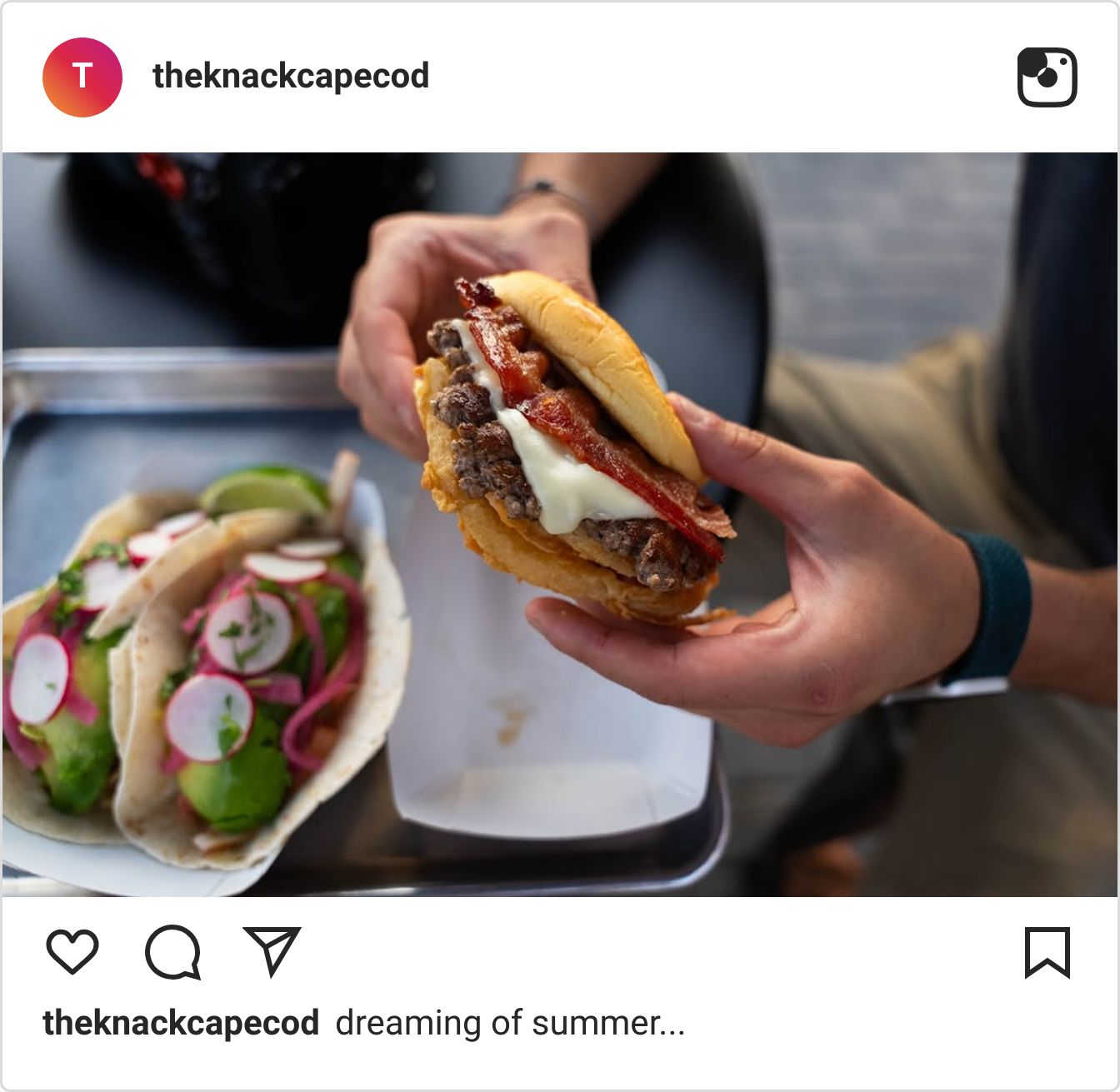
My favorite, weirdly enough, was one I encountered as we were driving home. The Knack, which has locations in Orleans and Hyannis, is a modern rendition of the classic Cape Cod roadside stand. Burgers and fries and onion rings, lobster rolls and whole belly clams, soft serve and shakes and ice cream sandwiches — generations of families, both local and tourists, have grown up on such delights. And The Knack’s goal is to perfect them, and in my view they’re pretty darn close. Everything tastes fresh and thoughtfully prepared, from the real, actual lettuce on my burger to the creamy, saline fried clams my wife ordered. The brick-and-mortar clearly takes design cues from Shake Shack (clean lines, metal chairs, poured concrete floors), though of course Cape-ified.
The Knack has been open for more or less a decade1, so it’s not entirely new, but still, I was impressed with both the food and the experience. And now that they’ve clearly got their operation locked down, I want to know: When are they going to build a franchise business? This place feels like it could be replicated throughout the Northeast, and maybe anywhere the lobster-and-clam supply chain can easily reach. If The Knack’s owners are reading this, might I suggest Downtown Brooklyn or Gowanus as a new testing ground?
1 Yeah, I haven’t been frequenting the Cape like I used to!